
Medford Wood Flooring takes on hardwood floor restoration in Medford, MA, and we are serving surrounding cities including Somerville, Malden, Winchester, Arlington and Everett. Restoration is for floors that need more than a sanding: old oak and pine under decades of shellac and wax, floors with missing or damaged boards, and floors scarred by radiators, pipes and earlier repairs.
The goal is to bring the original floor back rather than replace it with something new. That means removing what has been layered on top, repairing what is damaged with wood that matches, and finishing the whole floor so the repairs disappear and the character of the old wood remains.
After more than 20 years of wood floor work, much of it in older houses, we have learned to expect surprises under carpet, behind radiators and beneath layers of old finish. We look closely before quoting, so the surprises are ones we find, not ones you pay for halfway through the job.
Floors Worth Restoring
Oak Floors in Older Two-Families and Victorians
Medford grew fast around the turn of the last century, and its Queen Anne and Shingle style houses and its rows of two-family houses from that era often have oak floors that have been covered, painted around or worn but never replaced. Those floors are usually solid, well milled and worth keeping.
We check how much wood remains above the tongue, look for borders and inlays that should be preserved, and plan the repairs before sanding. A floor like this can often go another several decades once it is restored properly.
Eastern White Pine Floors
Older pine floors are soft, often wide and usually face-nailed with cut nails. They dent and wear easily, which is part of their character, and they respond badly to aggressive sanding.
We reset raised nails, replace split or rotted boards with reclaimed pine of matching width, and sand with a gentler grit sequence so the boards keep their slightly uneven, hand-worn surface. The finish is chosen to protect the soft wood without making it look plastic.
Floors Hidden Under Carpet and Linoleum
Many older floors were covered with carpet or linoleum decades ago, which protected the wood from wear but left tack strip holes, staples, carpet pad residue or adhesive behind. Under linoleum there may be black mastic or a layer of felt paper glued to the boards.
Mastic and old adhesives should be tested before anyone sands or scrapes them. Once they are dealt with, the wood beneath is often in better condition than the exposed floors elsewhere in the house.
Restoration Work Beyond Sanding
Stripping Shellac and Wax
Floors finished before modern polyurethane were usually coated in shellac and maintained with paste wax. Wax residue will stop a new finish from bonding, and it clogs sandpaper within minutes, so it has to be removed completely.
We test for wax, start with a coarse grit and change paper frequently until the old coatings are gone. Cutting corners here is the most common reason a new finish on an old floor peels within weeks.
Board Replacement With Matching Wood
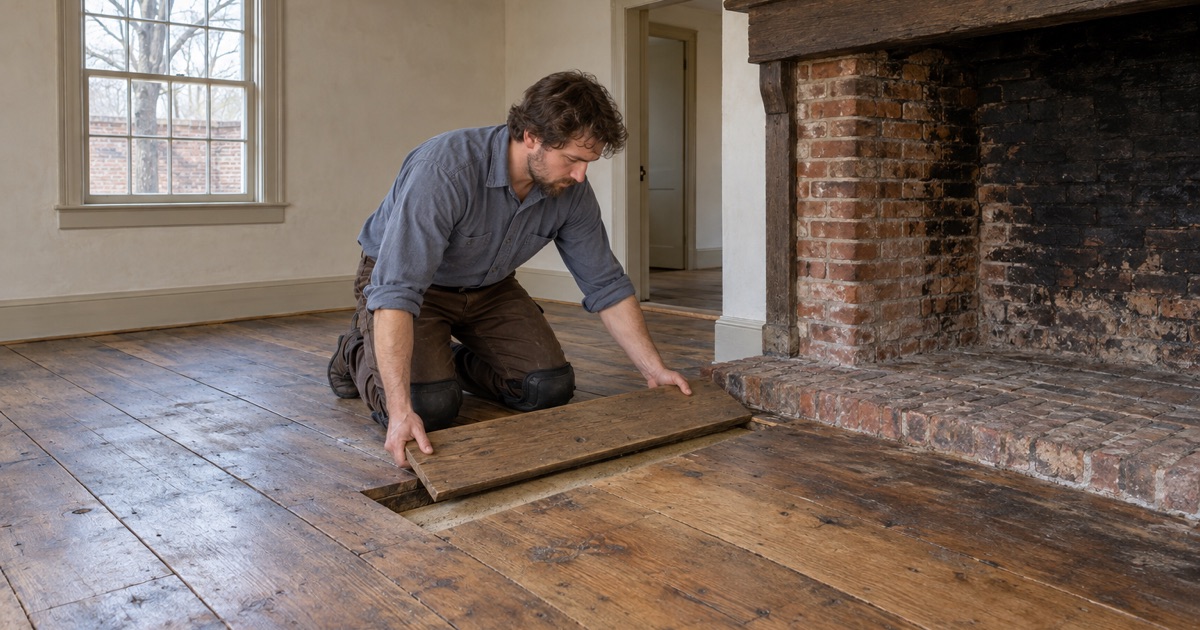
Damaged boards are cut out and replaced with wood that matches the species, width and grain of the original. The best source is often the house itself, such as a closet floor, with reclaimed stock as the next choice.
New boards are woven into the existing floor at staggered lengths, so there is no square patch. After sanding and finishing, the repairs blend into the surrounding floor.
Radiator Holes, Pipe Patches and Old Nails
When radiators and steam pipes come out, they leave holes and bare rectangles that were often filled with putty or covered with a scrap of wood. We remove those patches and weave in matching boards so the floor is continuous again.
Old cut nails that have worked up are reset below the surface, and loose boards are refastened. This preparation protects the sander and the finish, and it removes the small ridges and squeaks that make an old floor feel tired.
Historic Houses and Old Paint
Medford’s Historic Districts
Medford has two local historic districts, the Marm Simonds District centered on High Street in West Medford and the Hillside Avenue Historic District above the library. The city’s historic district guidance says those districts review exterior features visible from a public way and do not review interior changes or ordinary repair.
That means restoring the floors inside a house in either district does not need the commission’s approval. Work on a porch floor or other exterior surfaces visible from the street is a different matter, and owners should check with the city before starting it.
Lead-Safe Work on Painted Borders and Stairs
Many older floors have painted borders, painted stairs or painted boards in closets and back halls. In a house built before 1978, Massachusetts lead-safe renovation rules under 454 CMR 22.00 apply to disturbing those surfaces.
Those rules prohibit power sanding painted surfaces without HEPA-filtered exhaust and set requirements for containment and cleanup. We check the build year and the painted areas before quoting, so the restoration plan and the price already account for them.
Keeping Borders, Inlays and Period Details
Older oak floors sometimes carry a contrasting border, a band of darker wood around the room or a simple inlay at a doorway. These details are easy to damage with a drum sander run too close, and they are hard to replace once lost.
We sand borders and inlays with smaller machines and by hand, repair missing pieces with matching species, and finish them with the rest of the floor. The aim is a restored floor that still looks like it belongs to the house it is in.
- 20+ Years in Wood Flooring
- Stairs Priced by the Tread
- Moisture Readings Before Repairs