
Medford Wood Flooring repairs hardwood floor water damage in Medford, MA, serving surrounding cities including Somerville, Malden, Winchester, Arlington and Everett. We have spent more than 20 years dealing with floors after burst pipes, overflowing dishwashers and washing machines, and wet basements, and the lesson is always the same: the floor tells you what happened only if you let it dry before deciding what to replace.
Water damage is where rushing costs the most. A floor torn out on the first day might have dried flat, and a floor sanded while still wet will crown permanently. We trace the water, dry the boards and subfloor, read them with a moisture meter over the following days or weeks, and only then decide between sanding, board replacement and a new floor.
We also know that most water damage turns into an insurance question. We document damaged floors room by room for the adjuster, with photos, moisture readings and a clear description of which boards can be saved, so the claim and the repair are describing the same floor.
What Water Does to a Hardwood Floor
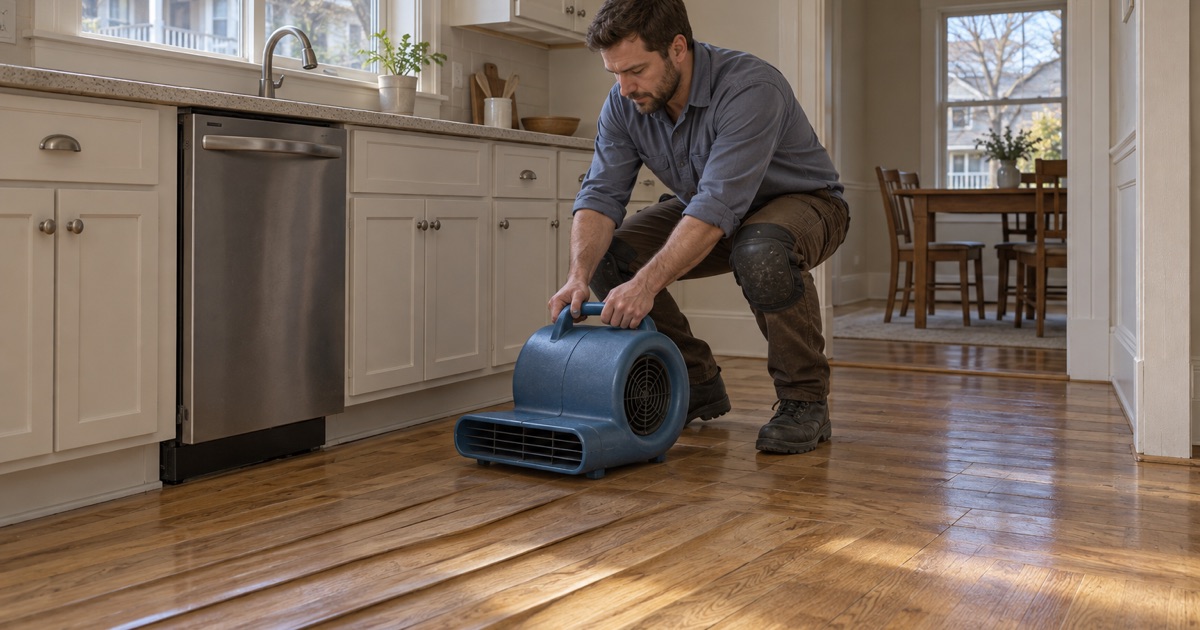
Cupping
Cupping happens when the underside of the boards absorbs more water than the top, so the edges rise above the centers and the floor looks like a series of shallow troughs. It usually means water came from below, from a leak into the subfloor, a wet crawl area or a damp basement.
Cupped floors often flatten as the moisture balances out. The key is to stop the water source and dry the floor evenly, rather than treating the cupping itself.
Crowning
Crowning is the opposite shape: the centers of the boards are higher than the edges. It sometimes comes from water on top of the floor, but more often it is the result of sanding a cupped floor flat before it had dried.
Once the boards finish drying after such a sanding, the edges shrink below the centers and the floor stays crowned. That damage is permanent, which is why we do not sand a water-damaged floor until the readings say it is ready.
Buckling
Buckling is the most severe reaction: the floor swells so much that it lifts off the subfloor, sometimes rising well above the rest of the room. It usually follows a large amount of water or water that sat for a long time.
Buckled boards are almost always replaced, and the fasteners and subfloor underneath need to be inspected. Even so, boards in the rest of the room may recover once the area is dried.
Where the Water Comes From
Burst Pipes and Appliance Leaks
A burst supply line, a failed dishwasher hose, a leaking refrigerator water line or an overflowing washing machine can soak a floor in minutes. The visible water is only part of it, since water runs along the subfloor and under the boards well beyond the wet area.
We map the damage with a moisture meter across the whole area, not just where the puddle was. That map tells us how far the water spread and which boards to watch as the floor dries.
Wet Basements and Sump Pumps
Water from below behaves differently from a single leak because it tends to return. A sump pump that cannot keep up, a wet foundation wall or water coming through the slab can keep a lower-level floor damp for months.
For these floors, the repair has to include the moisture source. We will not reinstall solid hardwood over a lower level that keeps getting wet; engineered wood or another moisture-tolerant floor, matched to the readings, usually makes more sense.
Storm Flooding in South Medford
The City of Medford itself describes neighborhoods such as South Medford as at risk of flooding and storm damage, and it has identified streets there with a history of flooding in heavy rain because of drainage capacity and slope. Water entering a house in those conditions often reaches the lower level first.
If your house has taken water in a storm before, it will likely do so again. We factor that into the choice of floor for any room that has flooded, and into how the floor is installed.
Our Step-by-Step Hardwood Floor Water Damage Process
Step 1: Stop and Trace the Water
The first job is to make sure the water has stopped and to find out where it came from. We look at plumbing, appliances, walls and the lower level, and if a plumber or waterproofing contractor is needed, we tell you before any floor work starts.
Step 2: Extract and Dry
Standing water is removed and the floor and subfloor are dried with air movement and dehumidification. In some cases a few boards are lifted to let air reach the subfloor, which speeds drying and shows how far the water spread.
We avoid blasting heat at a wet floor, which dries the top of the boards faster than the bottom and can make cupping worse or crack the wood. Steady, even drying from above and below gives the floor its best chance of settling back down.
Step 3: Monitor With a Moisture Meter
We take moisture meter readings across the damaged area and compare them with an unaffected part of the same floor. Readings are repeated until the wet area matches the dry one, which is the only reliable sign that the floor has finished moving.
The readings are recorded with the date and location of each one. That record shows the floor’s progress, supports the insurance claim and tells us when it is safe to sand without leaving the boards crowned.
Step 4: Document for the Adjuster
While the floor dries, we record the damage room by room: photos, moisture readings, species, board width, finish and square footage. The adjuster gets a clear picture of what is damaged and what can be saved.
Where a floor continues through several rooms without a break, we note that too, because a repair in one room often means refinishing the connected rooms so the color and sheen match. Leaving that out of the scope is a common reason a claim falls short of the real repair.
Step 5: Repair, Replace and Refinish
With the floor dry, we replace boards that did not recover, weave new wood into the old, and sand and refinish the area or the whole room so the repair blends in.
If the subfloor was damaged, it is replaced before any new boards go down, and fasteners that rusted in the wet are pulled. The goal is a floor that looks as if nothing happened and that will not move again the next time the season changes.
Insurance and Who Pays
Homeowner Policies Versus Flood Coverage
A sudden leak inside the house and water that comes from outside are usually handled by different kinds of coverage, and the adjuster decides which applies. Under the National Flood Insurance Program, a flood is defined as inundation of two or more acres or two or more properties, which is why a single house’s plumbing leak is not a flood claim.
We do not decide coverage and we do not tell you what a policy will pay. What we provide is an accurate account of the floor: what the water did, what can be saved and what has to be replaced, in a form an adjuster can use.
Basement Floors and the NFIP Exclusion
The NFIP treats any floor below ground level on all sides as a basement, including sunken rooms and split-level lower levels, and excludes finished flooring there from coverage. Before rebuilding a lower-level floor after a flood, it helps to know that the next one will probably not be covered either.
That is why a lower level that has flooded once is usually rebuilt with engineered wood over a vapor retarder, or with a floor that tolerates water, rather than with the solid hardwood that was there before.
- 20+ Years in Wood Flooring
- Stairs Priced by the Tread
- Moisture Readings Before Repairs